


Workwell Outsourcing

For recruitment agency leaders

Let’s talk

Playbook 2026

Five priorities for agency leaders

Five shifts shaping recruitment now, with practical advice on what to do next.

Start reading
In this playbook Let’s talk

Introduction

The recruitment market is changing

Client expectations are rising, margins remain under pressure and agencies are being asked to do more with less.

At Workwell Outsourcing, we work with recruitment agencies every day and see the same challenges emerge time and again: improving productivity, strengthening client relationships, embracing technology and building more resilient businesses.

This playbook brings together five priorities we believe are having the biggest impact on recruitment agencies today, alongside practical advice on how agency leaders can respond.

I hope you find it useful.

Hannah Mollison

Sales Director, Workwell Outsourcing

Landscape

The 2026 landscape in one page

After a difficult few years of economic uncertainty, employers are beginning to hire again.

There are encouraging signs that confidence is returning to the recruitment market. Recent REC and KPMG data shows permanent placements have stabilised, temporary billings continue to grow, and demand for temporary workers has increased for the first time in two years. The recovery remains uneven, but the direction of travel is more positive than it has been for some time.

Permanent placings
45 months of declining permanent placements ended in July
Job growth
10.4% year-on-year increase in active UK job postings in August 2026
Temporary billings growth
4th consecutive month of growth in temporary billings

That doesn’t mean recruitment has become easier.

Employers remain cautious about long-term commitments. Many are balancing growth plans with continued cost pressures, which is driving demand for more flexible workforce models. Temporary and contract recruitment is showing signs of strength, while permanent hiring remains under pressure in many sectors.

At the same time, agencies face a growing challenge that goes beyond vacancy volumes. Employers expect recruiters to do more than fill jobs. They want market insight, access to hard-to-find talent, support with workforce planning and advice on navigating rapid change.

The market isn’t short of people or opportunities. The challenge is connecting the right people to the right roles. Skills shortages, changing candidate expectations, workforce transformation and evolving client requirements are making that process more complex.

For recruitment agencies, this creates both risk and opportunity.

The agencies that succeed in 2026 are unlikely to be those relying on high volumes, transactional relationships or legacy ways of working. Instead, they will be the agencies that improve productivity, deepen client relationships, embrace technology where it adds value and build operating models that can adapt to change.

That’s the market this playbook is written for.

The five shifts

The recruitment market is changing faster than many agencies expected.

Clients are becoming more selective. Technology is changing how recruiters work. Pressure on margins remains high. And agencies are being asked to deliver more strategic value while operating more efficiently.

At Workwell Outsourcing, we work with recruitment businesses every day. Across the industry, five themes consistently stand out. Together, they represent some of the biggest opportunities and challenges facing recruitment agencies today.

  1. 01

    From volume to conversion

    Better candidate matching protects margin as well as delivery.

  2. 02

    From AI curiosity to workflow discipline

    Focus technology on specific business challenges and efficient workflows.

  3. 03

    Better adverts, better results

    Improve advert quality, system integration and reporting before adding more technology.

  4. 04

    Building a high-performing agency

    Sustainable growth comes from better systems, not longer hours.

  5. 05

    From revenue to profitability

    The best agencies optimise margin, not just turnover.

Shift one

From volume to conversion

Better candidate matching now protects margin as much as it improves delivery.

What’s changing

The market isn’t short of candidates. It’s short of the right candidates.

As hiring teams face increasing pressure to deliver better outcomes with fewer resources, employers are placing more emphasis on quality over quantity. Long shortlists carry less value than a small number of highly relevant candidates.

At the same time, hiring is becoming increasingly skills-focused.

First conversations
63% of jobseekers now expect the first hiring conversation to focus on practical, on-the-job experience.
Capability-based hiring
20% longer in role than degree-qualified counterparts.

What this means for your agency

The agencies creating the most value are focusing less on activity metrics and more on placement outcomes.

There are three practical opportunities for agencies:

  1. 01

    Help clients move beyond rigid job specifications that unnecessarily narrow the talent pool.

  2. 02

    Focus candidate presentations on evidence of capability, achievements and real-world experience rather than qualifications alone.

  3. 03

    Broaden your search to include candidates who may be overlooked by traditional hiring approaches, such as career changers, returners to work and professionals moving between sectors.

Shift two

From AI curiosity to workflow discipline

The AI conversation has matured. The winners aren’t the loudest adopters.

What’s changing

AI is rapidly becoming a standard part of recruitment.

What began as experimentation is now moving into day-to-day operations. Research suggests organisations using AI effectively are seeing significant gains in sourcing efficiency, recruiter productivity and candidate engagement. Industry data also shows AI is helping recruiters identify candidates that may otherwise be overlooked.

At the same time, workforce requirements continue to evolve.

Workforce change
82% of employers expect workforce skills to change significantly in the next three to five years.
Capability gaps
40% cite workforce and leadership capability as a critical skills gap.

What this means for your agency

The agencies seeing the biggest gains are focusing on specific business challenges first, then using technology to support those improvements.

The real question isn’t which AI platform to buy. It’s which process you can improve today and how quickly your team can adopt it successfully.

At Workwell Outsourcing, we believe there’s an important distinction between AI and automation. While AI dominates industry conversations, many of the most immediate productivity gains are still coming from process automation, reducing manual administration, improving accuracy and freeing people to focus on higher-value work.

The opportunity also extends beyond recruiter productivity. Employers are facing a period of significant workforce change, with skills requirements evolving faster than many organisations can keep up.

As businesses adapt, they need more than recruitment support. They need guidance on workforce planning, skills gaps and future talent requirements. Agencies that can contribute to those conversations, rather than simply filling vacancies, are more likely to become trusted partners.

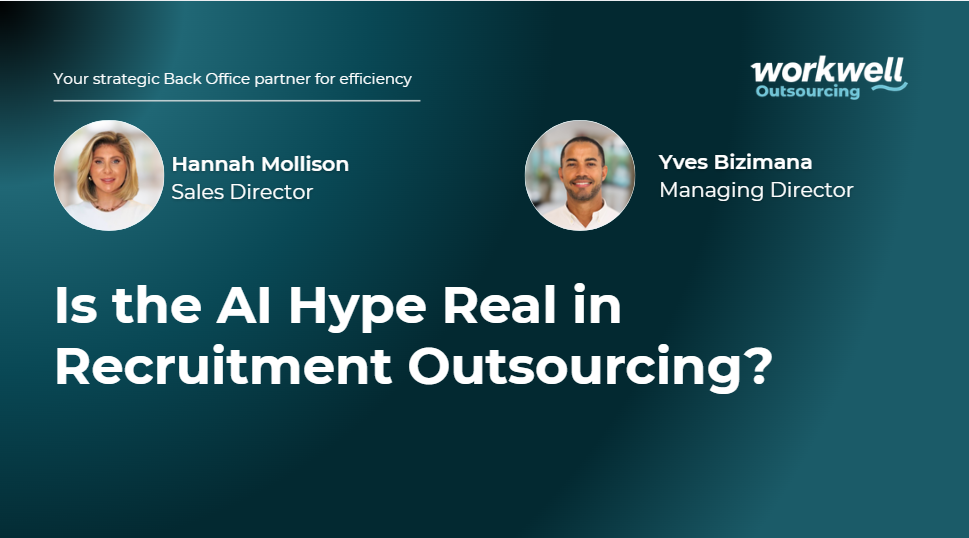
AI, Automation and the Reality Behind the Hype

AI has become one of the biggest talking points in recruitment, but where is technology genuinely creating value? In this short discussion, Hannah Mollison and Yves Bizimana explore the difference between AI and automation, why solving real business problems matters more than chasing buzzwords, and what recruitment agencies should focus on right now.

Shift three

Better adverts, better results

Poor data, poor processes and poor adverts all carry a cost.

What’s changing

In a more competitive hiring market, every application matters.

Yet research highlighted that 80% of job adverts fail basic spelling, grammar or formatting checks. Poor-quality adverts reduce visibility, limit candidate quality and ultimately increase recruitment costs.

Better adverts are often the result of better processes. In our experience, agencies struggling with advert quality are rarely facing a content problem alone. They’re often dealing with disconnected systems, inconsistent data and manual workflows behind the scenes.

Job advert quality
80% of job adverts fail basic spelling, grammar or formatting checks.

What this means for your agency

Small inefficiencies have a cumulative impact.

Duplicate logins, manual reporting and poor-quality data create unnecessary work across the recruitment process and reduce consultant productivity.

Often, improving advert quality, system integration and reporting processes delivers a faster return than investing in additional technology or advertising spend.

Shift four

Building a high-performing agency

Sustainable growth comes from better systems, not longer hours.

What’s changing

As agencies become more complex, performance is increasingly being driven by consistency rather than intensity.

The strongest businesses are not necessarily those asking people to work harder. They are creating clear expectations, stronger coaching cultures, more effective processes and better operating structures.

Across the industry, leadership teams are looking for ways to improve output without increasing headcount or creating burnout.

What this means for your agency

Where performance varies significantly, the answer is often structure rather than pressure.

Clear standards, meaningful metrics, effective coaching and fewer operational distractions create an environment where performance can be repeated consistently.

The challenge for many founders and directors is that too much leadership time is still being spent managing operations rather than driving growth.

What's Really Holding Agencies Back?

Many agency leaders focus on winning new business, but growth can quickly stall if the back office can’t keep pace. In this discussion, Hannah Mollison and Yves Bizimana explore how inefficient processes, poor billing workflows and operational bottlenecks can restrict growth, profitability and scalability.

Shift five

From revenue to profitability

The best agencies optimise margin, not just turnover.

What’s changing

Hiring confidence is beginning to improve, but the market remains uneven.

Recent REC and KPMG data indicates temporary billings have increased for four consecutive months, while temporary vacancies have risen for the first time in two years, highlighting continued demand for flexible workforce solutions.

At the same time, clients are increasingly consolidating suppliers and favouring agencies that can act as strategic partners rather than transactional providers.

Agency value
3% of Talent Acquisition leaders believe agencies add limited value.
Supplier consolidation
42% have reduced the number of agencies they use.

What this means for your agency

Revenue growth alone is no longer the best measure of success.

The agencies best positioned for long-term growth are improving profitability, strengthening client relationships and creating more resilient revenue streams.

The strategic question is no longer:

“How many clients do we have?”

It’s:

“Which client relationships can we deepen?”

The focus now should be on building a business that is not only growing but growing profitably. Agencies that strengthen client relationships, improve margins and create multiple revenue streams will be in the strongest position for long-term success.

Hannah Mollison
At Workwell Outsourcing, we work with recruitment agencies every day and see the same challenges emerge time and again: improving productivity, strengthening client relationships, embracing technology and building more resilient businesses.
Hannah MollisonSales Director, Workwell Outsourcing

Where should your agency focus next?

The challenges facing recruitment agencies are rarely isolated. Start with the area creating the most pressure today and discover one practical action you can take next.

Candidate relevance

Turn better matching into better outcomes.

Long shortlists carry less value than a small number of highly relevant candidates.

Your next 30 days

Review one live client brief and candidate presentation. Replace rigid qualification filters with evidence of capability, achievements and relevant experience.

Leadership question

Where are our current specifications narrowing the talent pool without improving hiring confidence?

Revisit volume to conversion

Workflow discipline

Choose the process before the platform.

The real question isn't which platform to buy. It's which process you can improve today and how quickly your team can adopt it successfully.

Your next 30 days

Choose one repeatable workflow. Define where technology can help, where human judgement remains essential and how quality will be measured.

Leadership question

Which recurring process creates the most avoidable work for our team today?

Revisit workflow discipline

Advert quality

Fix the friction already inside the system.

Duplicate logins, manual reporting and poor-quality data create unnecessary work and reduce consultant productivity.

Your next 30 days

Audit live adverts, reporting handoffs and duplicated data entry. Fix the issue with the clearest impact on candidate visibility or consultant time.

Leadership question

Which avoidable process is costing us the most candidate attention or consultant capacity?

Revisit better adverts

Operational excellence

Make strong performance repeatable.

Where performance varies significantly, the answer is often structure rather than pressure.

Your next 30 days

Choose one area where results vary. Clarify the standard, the metric, the coaching rhythm and the operational work that should be removed.

Leadership question

Where are we asking for more effort when the team actually needs a clearer system?

Revisit the high-performing agency

Profitable growth

Measure growth by the margin it creates.

Revenue growth alone is no longer the best measure of success.

Your next 30 days

Review clients, role types and revenue streams by contribution and relationship depth. Identify one relationship to deepen and one low-value activity to stop.

Leadership question

Which client relationships can we deepen?

Revisit revenue to profitability

More on the 2026 Recruitment Market

The themes in this playbook are based on the challenges recruitment agencies are facing right now. From funding and compliance to operational efficiency and scaling, these conversations explore how agencies are responding and where Workwell Outsourcing is helping them move forward. Watch the discussions below to dive deeper into some of the trends shaping the recruitment market in 2026.

Pay & Bill: Solving the Problem Behind the Problem

Many agencies come to us looking for a Pay & Bill platform. What we often discover is that the real challenge goes much deeper. In this discussion our team explains why agencies often underestimate the impact of inefficient back-office processes, and how the right support can unlock productivity, improve cash flow and support growth.

Compliance Confidence

Compliance is moving up the boardroom agenda. From candidate vetting and onboarding through to JSL and umbrella reform, agencies are looking for greater confidence that the right checks are being completed consistently. In this discussion, we look at the compliance challenges agencies are raising most frequently and how Workwell is helping them reduce risk.

Funding That Grows With Your Agency

As agencies scale, funding becomes about more than headline rates. Access to working capital, insurance limits and flexible funding structures can all impact growth. In this video, we explain why agencies are increasingly looking for funding partners that can grow alongside the business.

Protecting Working Capital

Growth depends on more than winning new business. From credit control and billing accuracy to cash collection and working capital, the efficiency of your back office has a direct impact on your ability to scale. In this discussion, Hannah and Yves Bizimana, MD, explore why operational processes are often the hidden factor behind growth challenges.

Let’s continue the conversation

If any of this sounds like a conversation worth having, we’d love to hear from you.

Video

Frequently asked questions

Short answers to the practical questions behind the five shifts.

What are the five priorities for recruitment agency leaders in 2026?

The playbook focuses on moving from volume to conversion, adopting AI through disciplined workflows, improving job adverts, building a high-performing agency and prioritising profitable growth.

How can recruitment agencies use AI more effectively?

Start with one repeatable workflow, identify where automation or AI can add value, keep human judgement where it matters and agree how success will be measured.

What should agencies measure beyond revenue?

Review contribution, margin, relationship depth and the capacity each client, role type and channel consumes so growth decisions reflect profitability as well as turnover.

How can Workwell Outsourcing support recruitment agencies?

Workwell Outsourcing supports recruitment agencies through outsourced back-office services, specialist support, funding and recruitment technology, helping teams reduce manual administration and build more efficient operating models.

Sources & acknowledgements

This playbook is informed by Workwell Outsourcing’s experience supporting recruitment agencies across the UK, alongside industry research, labour market data and insights shared by recruitment leaders throughout 2026.

Key sources

  • Recruitment & Employment Confederation (REC)
  • KPMG & REC Report on Jobs
  • Indeed and Indeed Hiring Lab
  • LinkedIn Talent Solutions
  • The Talent Labs
  • Industry leaders and speakers at the TRN Summer Retreat 2026
Acknowledgements & methodology

With thanks

  • Neil Carberry, CEO, Recruitment & Employment Confederation
  • Matt Burney, Senior Strategic Advisor, Indeed
  • Emma Mirrington, The Talent Labs
  • Rob Prince, TRN
  • Grant Leboff
  • Dave Hazlehurst & Natalie Hughes, Agentic People
  • Cally Beaton
  • Jim Steele
  • Tracey Hill

The views, recommendations and commercial applications within this playbook are Workwell Outsourcing’s own and are based on a combination of market research, industry insights and our experience supporting recruitment businesses.

With thanks to TRN for hosting the Summer Retreat 2026 and facilitating many of the conversations that helped shape this content.